

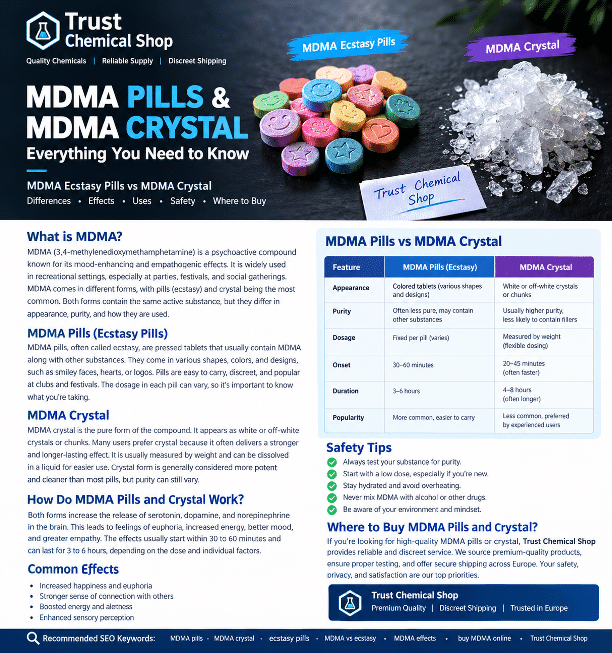
MDMA is a psychoactive substance commonly associated with the names ecstasy, Molly, crystal MDMA, and MDMA powder. It is often discussed in connection with nightlife and recreational drug use because of its stimulant and empathogenic effects. However, products sold under these names can vary considerably in composition and strength, creating significant health and safety concerns.
This guide from Trust Chemical Shop provides general educational information about MDMA pills vs MDMA crystal, explains the differences between these forms, and highlights important safety considerations.
What Is MDMA?
MDMA, short for 3,4-methylenedioxymethamphetamine, is a synthetic psychoactive compound with stimulant and entactogenic properties. It can affect several neurotransmitter systems, particularly serotonin, dopamine, and norepinephrine. Reported effects can include increased energy, altered perception, elevated mood, and feelings of emotional closeness.
The term “ecstasy” commonly refers to MDMA in tablet form, while “Molly” or “MDMA” may refer to powder or crystalline material. Importantly, these names do not guarantee that a product contains only MDMA.
What Are MDMA Pills?
MDMA pills, commonly called ecstasy tablets, are pressed tablets that may contain MDMA together with other substances. They can have different colors, shapes, sizes, logos, and designs.
One important concern is that tablet appearance does not reliably indicate its contents. Public-health information reports that ecstasy tablets can contain different concentrations of MDMA or other substances, including stimulants and other psychoactive compounds.
Consequently, two tablets that look almost identical can have very different chemical compositions.
Key Characteristics of MDMA Pills
- Usually produced as compressed tablets
- Available in numerous colors and designs
- May contain MDMA or other substances
- Chemical composition can vary significantly
- Appearance cannot reliably establish purity or strength
What Is MDMA Crystal?
MDMA crystal refers to MDMA in a crystalline or powder-like physical form. It is sometimes described as white, grey, or off-white crystalline material.
Although crystalline material may appear more uniform than tablets, appearance still does not prove chemical identity or purity. Products sold as MDMA powder or crystal may contain additional substances or may not contain the substance represented by the seller.
Therefore, it is inaccurate to assume that crystal MDMA is automatically pure or safer than an ecstasy tablet.
MDMA Pills vs MDMA Crystal
The primary difference between these two forms is their physical presentation, rather than necessarily their underlying active substance.
| Feature | MDMA Pills / Ecstasy | MDMA Crystal |
|---|---|---|
| Physical form | Compressed tablet | Crystalline or powder-like material |
| Appearance | Often colored or stamped | Commonly white, grey, or off-white |
| Composition | May contain MDMA and other substances | May contain MDMA and other substances |
| Consistency | Can vary between tablets | Can vary between samples |
| Purity | Cannot be determined from appearance | Cannot be determined from appearance |
| Main concern | Unknown contents and variable strength | Unknown contents and variable purity |
The distinction is therefore more complicated than simply “pills versus pure crystal.” Neither physical form provides a reliable indication of safety.
How Does MDMA Affect the Body?
MDMA influences neurotransmitter activity in the brain and can produce both psychological and physical effects. People may experience increased alertness, elevated mood, emotional openness, altered sensory perception, or anxiety.
Physical effects can include increased heart rate, increased body temperature, sweating, muscle tension, nausea, and involuntary teeth clenching.
The risks can become more serious when MDMA contributes to overheating, cardiovascular stress, or dangerous changes in the body’s fluid and electrolyte balance.
Why Does MDMA Purity Matter?
One of the major challenges associated with illicit MDMA products is uncertainty about their contents. Research and public-health organizations have documented cases where tablets sold as ecstasy contained other drugs or mixtures of substances.
Recent European drug warnings have also highlighted tablets containing PMMA, a stimulant that can cause severe illness and potentially death. The warning emphasizes that a tablet’s color, shape, or logo cannot establish what it contains.
This uncertainty makes it particularly important not to equate a particular appearance with a particular chemical composition.
Potential Health Risks of MDMA
MDMA can present serious health risks, particularly in hot environments or when combined with other substances. Potential adverse effects include:
- Increased heart rate and blood pressure
- Increased body temperature
- Confusion or anxiety
- Nausea and vomiting
- Muscle tension and jaw clenching
- Dehydration or dangerous fluid imbalance
- Hyperthermia
- Cardiovascular complications
- Serious toxicity in cases involving adulterated substances
NIDA notes that severe hyperthermia can potentially contribute to liver, kidney, or cardiovascular failure.
Mixing MDMA with alcohol, stimulants, or other psychoactive substances can introduce additional risks.
MDMA Pills vs Crystal: The Important Takeaway
When comparing MDMA ecstasy pills vs MDMA crystal, the physical form is only one part of the issue. A tablet is compressed into a solid form, while crystal or powder is a loose material, but neither appearance nor format proves purity, strength, or safety.
The chemical identity and composition of an unknown product cannot reliably be established simply by looking at it. This is particularly important because illicit products may contain unexpected substances.
Legal and Research Considerations
MDMA is controlled or restricted in many countries. Laws differ by jurisdiction, and possession, production, distribution, and use can carry significant legal consequences.
For organizations such as Trust Chemical Shop, any information concerning MDMA should clearly distinguish legitimate scientific or analytical research from recreational use. Researchers and laboratories should follow applicable regulations, institutional procedures, chemical-safety requirements, and licensing obligations.
Frequently Asked Questions
- Is MDMA crystal the same as ecstasy?
MDMA crystal and ecstasy can refer to different physical forms associated with MDMA. Ecstasy generally refers to tablets, while crystal or powder describes a loose physical form. However, products sold under either name may contain additional substances.
- Are MDMA pills always pure MDMA?
No. Public-health sources report that ecstasy tablets can contain varying concentrations of MDMA and other substances.
- Does crystal MDMA mean higher purity?
Not necessarily. A crystalline appearance does not establish chemical purity or identity.
- Can you identify an MDMA tablet by its logo or color?
No. Current drug warnings emphasize that appearance cannot reliably reveal the contents of a tablet.
- Is MDMA legal?
The legal status varies by country. Anyone handling controlled substances for legitimate research should consult the laws and regulatory requirements applicable to their location.
Conclusion
MDMA pills and MDMA crystal represent different physical presentations commonly associated with MDMA. Pills are compressed tablets that may contain varying amounts of MDMA or other substances, while crystal or powder is a loose form whose appearance likewise cannot establish purity.
For anyone researching MDMA, understanding the distinction between physical form, chemical composition, purity, and legal status is essential. Trust Chemical Shop can use this information as an educational resource while emphasizing responsible chemical handling, regulatory compliance, and accurate scientific information.